
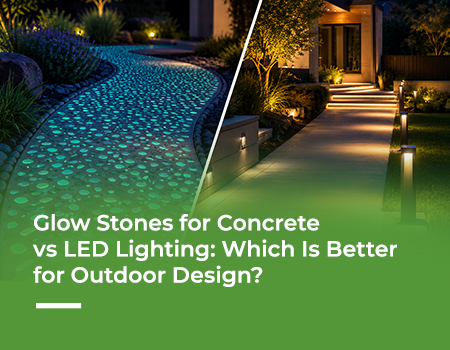
When planning an outdoor space, lighting is one of the most important design decisions you’ll make. It affects not only how the area looks at night, but also how it feels, how safe it is, and how much maintenance it will need over time.
For years, LED lighting has been the default option for pathways, driveways, pool surrounds, and outdoor entertaining areas. However, that’s no longer the only solution.
More homeowners, landscapers, and designers are now comparing LED systems with PolyGlow Glow Stones—a decorative concrete finish that absorbs light during the day and emits a soft glow at night.
At first glance, both options improve nighttime visibility. Yet in practice, they deliver very different results.
So which one is better for outdoor design?
The answer depends on what matters most to your project: brightness, maintenance, cost, design flexibility, or long-term simplicity.
In this guide, we’ll compare glow stones for concrete vs LED lighting across the factors that matter most—so you can choose the right solution for your outdoor space.
Why This Comparison Matters
At first, glow stones and LED lighting may seem like two completely different products. Technically, they are. However, in outdoor design, they often solve the same problem.
Both are used to:
- Improve nighttime visibility
- Add atmosphere to outdoor spaces
- Increase safety in low-light areas
- Create visual interest after dark
That means they are often competing for the same role in a project.
The difference is how they achieve it.
LED lighting relies on power, wiring, fixtures, and installation. Glow stones, by contrast, are embedded into the concrete surface and charge naturally through light exposure.
As a result, the decision often comes down to this:
Do you want a powered lighting system—or a low-maintenance architectural finish that glows on its own?
How Glow Stones and LED Lighting Work
To compare them properly, it helps to understand how each one functions.
LED lighting works by using electrical current to power small light fixtures. These may be installed in pathways, recessed into paving, mounted under steps, or integrated into landscape features.
Glow stones work differently.
PolyGlow Glow Stones absorb natural or artificial light during the day and gradually release it in darkness. According to the U.S. Department of Energy’s research on photoluminescent materials, this glow occurs when light energy is stored and slowly emitted over time.
In practical terms, LEDs produce active light, while glow stones produce passive light.
That distinction changes everything.
Daytime Appearance: Which Looks Better?
One of the biggest differences between these two options is what they look like during the day.
This matters because outdoor lighting is not just about nighttime performance. In fact, most of the time, your outdoor surfaces are seen in daylight.
That’s where glow stones often have the advantage.
Because they are embedded into the concrete, PolyGlow Glow Stones become part of the surface itself. During the day, they function like a decorative aggregate—adding texture, colour, and design interest without looking like a lighting fixture.
LEDs, on the other hand, remain visible as fixtures, strips, housings, or lenses. Even when turned off, they still look like installed lighting.
For projects where a cleaner, more integrated finish matters, glow stones usually create a more refined result.
This is especially true in premium architectural surfaces where the design needs to feel seamless.
For example, many designers compare colour and finish combinations before selecting their final glow stone blend in Best Glow Stone Colours for Concrete.
Night Performance: Which Performs Better After Dark?
At night, the comparison becomes more nuanced.
LEDs are brighter. There’s no question about that.
If your primary goal is strong illumination, active brightness, or directional task lighting, LEDs will outperform glow stones.
However, brightness is not always the goal.
In many outdoor spaces, the aim is not to flood the area with light—it’s to create atmosphere, subtle guidance, and low-level visibility.
That’s where glow stones perform exceptionally well.
Rather than producing a sharp artificial light, glow stones create a softer ambient glow that feels more architectural and less intrusive.
For pathways, pool surrounds, decorative concrete, and entertaining areas, this often creates a more premium look.
So while LEDs win on brightness, glow stones often win on ambience.
Maintenance and Long-Term Upkeep
This is where the difference becomes much more significant over time.
LED systems require:
- Wiring
- Transformers
- Installation hardware
- Occasional replacement
- Ongoing maintenance
Even well-installed systems may eventually need repairs, replacements, or troubleshooting—especially in exposed outdoor environments.
By contrast, glow stones have no wiring, no power source, and no electrical components.
Once installed, they simply become part of the concrete surface.
That means no bulbs to replace, no cables to maintain, and no electrical faults to troubleshoot.
For many homeowners and commercial projects, that simplicity becomes one of the biggest long-term advantages.
Which Is More Cost Effective?
Upfront, glow stones and LEDs can vary depending on the scope of the project.
LED systems often carry:
- Product cost
- Electrical installation cost
- Labour
- Long-term maintenance cost
Glow stones are typically integrated during the concrete finishing process, which can simplify installation and reduce future maintenance expenses.
That means while LEDs may offer stronger active lighting, glow stones often offer better long-term value where low-maintenance design is the priority.
A Smarter Alternative for Low-Maintenance Outdoor Design
If long-term maintenance, clean design, and ease of ownership matter to your project, PolyGlow Glow Stones offer a simpler alternative to traditional outdoor lighting.
Explore premium PolyGlow Glow Stones designed for decorative concrete, pathways, and outdoor architectural surfaces.
Design Flexibility and Surface Finish
Another major advantage of glow stones is how naturally they integrate into the surface.
Because they are embedded into the concrete, they allow for far more flexibility in finish design.
They can be:
- Broadcast into exposed aggregate
- Integrated into polished concrete
- Used in pathways and edging
- Paired with decorative aggregates for custom finishes
For example, many designers combine glow stones with clear crushed glass to create a lighter, cleaner daytime finish.
For bolder architectural contrast, coloured crushed glass can be used to build more visual depth.
LEDs, by comparison, are more limited. They function as add-ons rather than integrated finishes.
That makes glow stones significantly more versatile in decorative concrete applications.
Safety and Practical Use
Both solutions improve nighttime usability, but they do so differently.
LEDs improve visibility through brightness and direct illumination.
Glow stones improve visibility through subtle edge definition, ambient glow, and low-light guidance.
For example:
- LEDs are better for stairs and strong directional lighting
- Glow stones are better for pathways, borders, pool edges, and decorative guidance
In many cases, the best solution depends on whether you need illumination—or orientation.
Which Option Is Better for Outdoor Design?
The better option depends on the purpose of the space.
Choose LED lighting if:
- You need strong brightness
- You need task lighting
- You need active illumination
Choose glow stones if:
- You want lower maintenance
- You want a more integrated finish
- You want subtle architectural lighting
- You want the surface to look premium during the day and at night
For many outdoor design projects, glow stones offer a better balance of function, finish, and long-term simplicity.
Choose the Right Lighting Finish for Your Outdoor Space
There is no single “best” outdoor lighting solution—only the best solution for the way you want the space to function.
If brightness is the priority, LEDs may be the better fit.
However, if your priority is cleaner design, lower maintenance, and a more seamless architectural finish, glow stones are often the smarter long-term choice.
That’s why more designers and homeowners are now choosing PolyGlow Glow Stones over traditional outdoor lighting systems.
Explore PolyGlow Glow Stones for Your Next Outdoor Project
If you’re looking for a lower-maintenance alternative to LED lighting, start with a surface designed to perform beautifully in both daylight and after dark.
Explore premium PolyGlow Glow Stones for pathways, pool surrounds, driveways, and outdoor concrete design.